

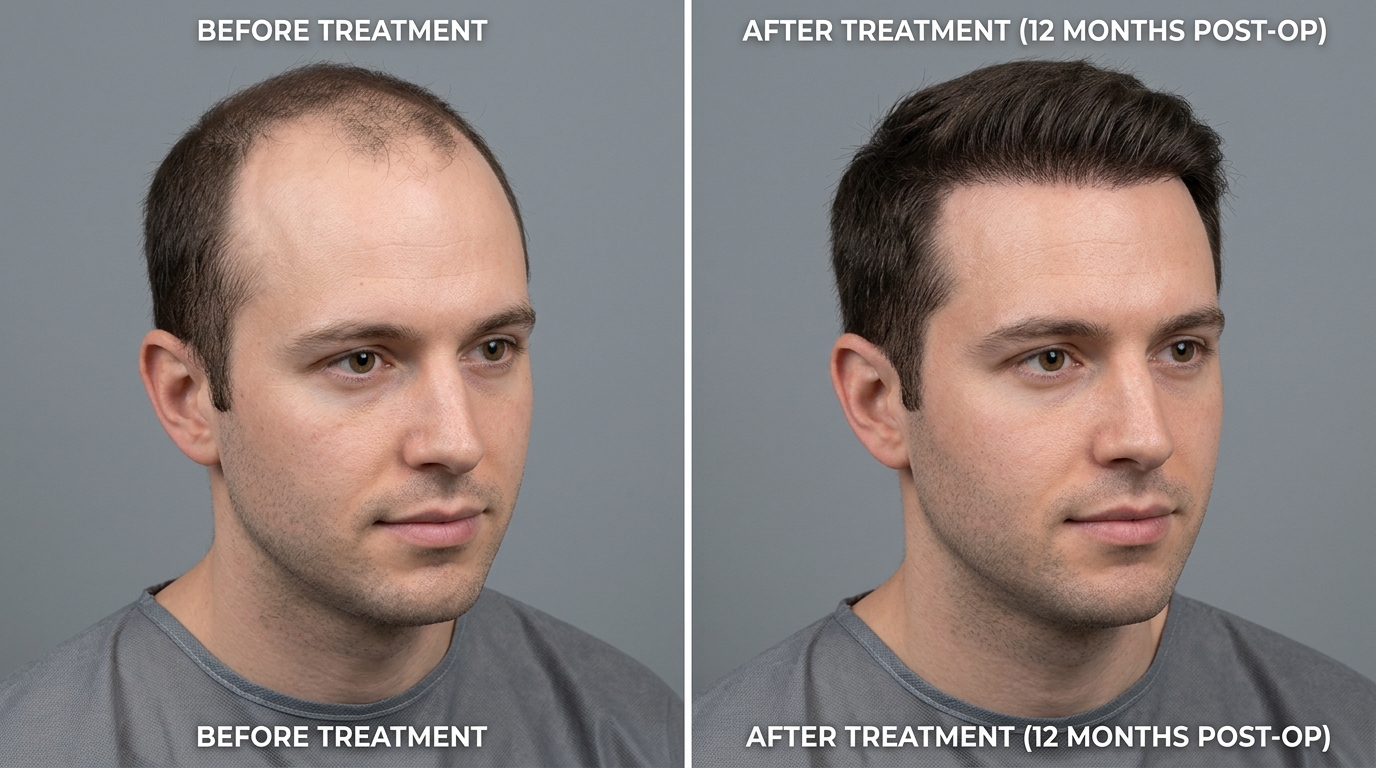
Key Clinical Takeaways
- The crown vertex is a spherical anatomical dome where hairs radiate outwards like a spiral spiral whorl, requiring 30% more surface area coverage.
- Frontal hairline restoration prioritizes immediate facial framing and visual density per square centimeter.
- Strategic donor allocation ensures adequate reserve grafts remain should genetic thinning progress in future years.
The Radial Geometry of the Vertex Whorl
Unlike the frontal zone where hair grows forward at a 30 to 45 degree angle, the crown features a spiral swirl (vortex) where hairs splay out in 360 degrees. Because hairs don't overlap in a single direction, achieving the illusion of density demands meticulous angle variation and multi-hair follicular groupings.
- Hairline: 45–55 grafts/cm² for dense natural coverage.
- Crown: 35–45 grafts/cm² with high multi-hair follicular unit placement.
- Donor stewardship: Conserving at least 2,000 reserve grafts for later life.
"No two scalps or skin barriers share identical biological parameters. True clinical excellence lies not in aggressive standard packages, but in microscopic diagnosis and mathematically calibrated preservation tailored to Indian skin."

Dr. Navnit Haror
MBBS, MD - Dermatology (Gold Medalist), ISHRS • Founder & Chief Dermatologist, Hair Restoration Specialist
Practicing in Ahmedabad at Dr. Haror's Wellness, dedicated to high-precision robotic hairline restoration, microscopic follicular viability, and evidence-based clinical dermatology.
Consult with Navnit